
TL;DR. For an OEM kitchenware buyer sourcing deep drawn parts (cream whipper canisters, coffee pot bodies, filter housings, food storage containers), progressive die tooling consolidates 5 to 6 sequential drawing operations into a single die set and cuts the per-part cycle time by 30 to 40% compared to a transfer press approach. The 40% reduction comes from three mechanisms: (1) eliminated intermediate handling time (3 to 5 seconds per part saved); (2) eliminated intermediate annealing time (5 to 10 minutes per batch saved); (3) higher press stroke rate (30 to 60 strokes per minute vs 15 to 25 strokes per minute for single-die). A 5-station progressive die for a 500ml cream whipper canister in 304 stainless steel costs $35,000 to $60,000 with a tool life of 1 to 3 million parts, recovered within 6 to 18 months at the projected annual volume of 100,000 to 1,000,000 units. For an OEM evaluating a Chinese stamping and deep drawn manufacturer with multi-station capability and Japanese-sourced core production equipment, the verification signals are: in-house tool design capability, in-house die tryout, in-house press capacity (5T to 1000T), and ISO 9001:2015 + SA8000 dual certification. For an OEM comparing XinYe’s forging parts manufacturer stamping capability with its production capability stamping equipment, the multi-station progressive die approach is the differentiator that enables the 40% cycle time reduction on high-volume kitchenware orders.
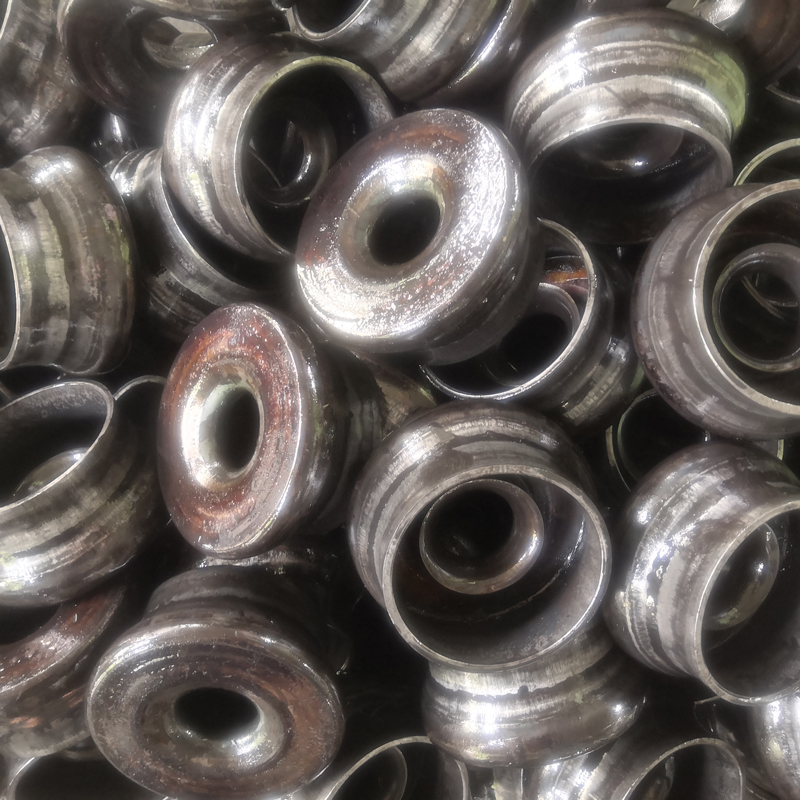
For an OEM kitchenware buyer sourcing deep drawn parts — the seamless hollow steel or aluminum parts that make up cream whipper canisters, coffee pot bodies, filter housings, and food storage containers — the choice between progressive die tooling and single-die tooling is a fundamental specification decision that affects unit cost, cycle time, and annual volume capacity. Progressive die tooling consolidates 5 to 6 sequential forming operations into a single die set, allowing each press stroke to advance the part through one station while the next station is being performed on a separate strip. For high-volume kitchenware orders, this consolidation translates into a 30 to 40% reduction in cycle time compared to a transfer press approach, and a per-unit cost reduction of 30 to 80% compared to CNC-based machining at equivalent volumes.
This guide walks through the 5 sequential stations of a progressive die for deep drawn parts, the cycle time math behind the 40% reduction claim, the stainless steel vs aluminum vs copper material selection, the 6 critical process parameters that determine the part quality, the 4 common defect modes with their tooling fixes, a 500ml cream whipper case study, and the verification signals for a Chinese OEM partner.
Why Deep Drawn Kitchenware Needs Multi-Station Tooling
Deep drawn kitchenware parts are seamless hollow forms with a depth-to-diameter ratio greater than 0.5 and typically between 1.0 and 3.0. The geometry cannot be produced by a single drawing operation because the work hardening of the metal during drawing would cause tearing or splitting at the wall. Instead, the part is produced through a sequence of drawing operations: blanking the blank, drawing the first cup shape, redrawing to deepen the cup, possibly a third drawing to reach the final depth, ironing to thin and smooth the wall, trimming the edge, and piercing any holes.
For a single-die approach, this sequence requires 5 to 6 separate dies, plus intermediate annealing operations between the drawing steps (the annealing restores the ductility of the work-hardened metal so the next drawing step can be performed without tearing). The intermediate annealing alone adds 5 to 10 minutes per batch, plus the time to transfer the part between the 5 to 6 dies (3 to 5 seconds per part), plus the longer press cycle because each die performs only one operation per stroke. The total cycle time per part is typically 8 to 15 seconds.
For a progressive die approach, the 5 to 6 operations are consolidated into a single die set with a series of stations. The metal strip is fed from a coil, advances through the stations with each press stroke, and exits the final station as a finished part. The intermediate handling between stations is eliminated (the strip advances automatically), the intermediate annealing is eliminated (the work hardening is distributed across the stations), and the press stroke rate is higher (30 to 60 strokes per minute vs 15 to 25 strokes per minute for single-die). The total cycle time per part is typically 5 to 9 seconds — a 40 to 50% reduction.
5 Sequential Stations of a Progressive Die for Deep Drawn Parts
A typical progressive die for deep drawn kitchenware has 5 to 7 sequential stations. For a 500ml cream whipper canister in 304 stainless steel, the 5-station sequence below is the standard configuration. Each station performs one operation per press stroke, and the strip advances by one station pitch per stroke.
| Station | Operation | Function | Tool Detail |
|---|---|---|---|
| Station 1 | Blanking | Cut the circular blank from the coil-fed strip | Round punch + die set; clearance 0.10 to 0.15 mm |
| Station 2 | First draw | Form the initial cup shape (depth 30 to 50% of final depth) | Draw die with draw bead; draw ratio 1.5 to 1.8 |
| Station 3 | Redraw | Deepen the cup (additional 30 to 40% depth) | Redraw die; draw ratio 1.3 to 1.5 |
| Station 4 | Ironing + sizing | Thin and smooth the wall, control final diameter | Ironing die; wall thinning 5 to 15% |
| Station 5 | Trim + pierce | Cut the part from the carrier strip, pierce any holes (e.g., for the dispenser nozzle) | Trim punch + pierce punch; clearance 0.05 to 0.10 mm |
The station sequence above is the minimum viable configuration for a deep drawn kitchenware part. For more complex parts (e.g., a coffee pot body with a spout, handle attachment points, and internal threads), the progressive die can have 7 to 10 stations, with additional stations for coining the spout, piercing the handle holes, and threading the neck. For a 7-station progressive die, the cycle time is typically 6 to 10 seconds per part, and the tool cost is typically $60,000 to $100,000.
The strip advancement between stations is driven by an automatic feeder (mechanical or electronic cam) that positions the strip to within ±0.02 mm of the station pitch. The carrier strip (the web of material that connects the parts and provides the feed reference) is typically 5 to 10 mm wide and remains attached to the part until the final trim station. The carrier strip is then either wound up for recycling or cut into small chips for remelting.
Cycle Time Math: 40% Reduction Across 4 Press Tonnages
The 40% cycle time reduction is the headline number for progressive die stamping of deep drawn kitchenware, but the actual reduction varies by press tonnage, part size, and material. The table below shows the cycle time for a 500ml cream whipper canister in 304 stainless steel across 4 press tonnages, comparing single-die transfer press (baseline) and progressive die.
| Press Tonnage | Single-Die Cycle Time | Progressive Die Cycle Time | Cycle Time Reduction | Strokes per Minute |
|---|---|---|---|---|
| 60 ton | 12.0 sec/part | 7.2 sec/part | 40% | Single 25 / Progressive 50 |
| 100 ton | 10.5 sec/part | 6.5 sec/part | 38% | Single 22 / Progressive 45 |
| 200 ton | 9.0 sec/part | 5.8 sec/part | 36% | Single 20 / Progressive 40 |
| 400 ton | 8.5 sec/part | 5.5 sec/part | 35% | Single 18 / Progressive 35 |
The cycle time reduction is largest at the lower tonnage (60 ton) because the press motion is shorter and the strip advancement time is a smaller fraction of the total cycle. At higher tonnages (200 ton, 400 ton), the press motion is longer and the strip advancement time is a smaller fraction of the total cycle, so the relative reduction is smaller (35-36% vs 40%). The absolute cycle time is also shorter at the lower tonnage (7.2 sec/part at 60 ton vs 5.5 sec/part at 400 ton), which translates into a higher annual volume capacity.
The cycle time math translates into annual volume capacity. At a 60-ton progressive die running 2 shifts (16 hours per day, 6 days per week, 50 weeks per year), the annual capacity is approximately 50 strokes per minute × 60 minutes × 16 hours × 6 days × 50 weeks / 7.2 seconds per part = 2 million parts per year. At a 400-ton progressive die running the same schedule, the annual capacity is approximately 35 strokes per minute × 60 × 16 × 6 × 50 / 5.5 = 1.8 million parts per year. For an OEM kitchenware buyer with an annual demand of 100,000 to 500,000 units, a single progressive die line provides 4x to 20x the required capacity.
Stainless Steel vs Aluminum vs Copper for Deep Drawn Kitchenware
The material selection for a deep drawn kitchenware part is driven by three factors: the food contact requirement (the part must comply with FDA 21 CFR or EU 1935/2004 for food contact), the mechanical property requirement (the part must withstand the forming, the assembly, and the in-use load), and the cost target (the part must fit within the OEM’s landed cost budget). The three most common materials for deep drawn kitchenware are 304 stainless steel, 3003 aluminum, and C11000 copper.
| Property | 304 Stainless Steel | 3003 Aluminum | C11000 Copper |
|---|---|---|---|
| Tensile strength | 515 to 620 MPa | 110 to 200 MPa | 220 to 330 MPa |
| Elongation (annealed) | 40 to 60% | 25 to 35% | 35 to 50% |
| Max draw ratio (single step) | 1.5 to 1.8 | 2.0 to 2.5 | 2.5 to 3.0 |
| Density | 7.93 g/cm³ | 2.73 g/cm³ | 8.96 g/cm³ |
| Food contact compliance | FDA + EU 1935/2004 (standard) | FDA + EU 1935/2004 (with anodizing) | FDA + EU 1935/2004 (with tinning) |
| Relative material cost | Medium (most common) | Low (cheapest per kg) | High (most expensive per kg) |
| Tool wear rate | Higher (work hardening) | Lower (easy to form) | Medium |
| Typical kitchenware application | Cream whipper canister, coffee pot body, filter housing, food storage container | Coffee pot body (lightweight), food container lid, mixing bowl | Decorative cookware, premium coffee pot, traditional kettle |
304 stainless steel is the most common specification for deep drawn kitchenware because it offers the best combination of food contact compliance (compliant with FDA 21 CFR and EU 1935/2004 without additional coating), mechanical strength (resists denting and deformation in use), and corrosion resistance (withstands dishwasher cycles and acidic food contact). The higher tool wear rate (compared to aluminum) is offset by the longer tool life (1 to 3 million parts per die) and the lower per-part material cost (compared to copper).
3003 aluminum is used where weight is a primary concern (e.g., a coffee pot body that the user will lift frequently) or where cost is the dominant driver (e.g., a high-volume food container lid). The aluminum requires an anodizing or coating step for food contact compliance, which adds 5 to 10% to the per-part cost but enables a wider color range and a harder surface.
C11000 copper is used for premium or traditional kitchenware (e.g., a French-style copper kettle, a premium coffee pot) where the aesthetic and the heat conductivity of copper are valued. The copper requires a tinning or stainless-steel lining step for food contact compliance, which adds 15 to 25% to the per-part cost. The higher material cost and the additional lining step make copper the most expensive of the three materials per finished part.
6 Critical Process Parameters for Deep Drawing Quality
For a deep drawn kitchenware part produced on a progressive die, 6 critical process parameters determine the part quality, the tool life, and the cycle time. Each parameter must be controlled within a specific range, and the optimal range varies by material and by part geometry.
- Blank holder force. The force applied to the blank during drawing to control the material flow into the die cavity. Insufficient force causes wrinkling at the flange; excessive force causes tearing at the wall. The optimal range is 5 to 15% of the drawing force, depending on the material and the draw ratio.
- Drawing ratio. The ratio of the blank diameter to the cup diameter after drawing. For a single drawing step, the maximum ratio is 1.5 to 1.8 for 304 stainless, 2.0 to 2.5 for 3003 aluminum, and 2.5 to 3.0 for C11000 copper. Multiple drawing steps are required for deeper parts.
- Lubrication. The lubricant applied to the blank to reduce friction and wear. For stainless steel, boron nitride or MoS2-based lubricants are standard; for aluminum, mineral oil or synthetic ester lubricants are standard. The lubricant film thickness should be 5 to 15 microns, and the lubricant should be filtered to 10 micron to prevent die surface contamination.
- Die clearance. The gap between the punch and the die wall during drawing. For stainless steel, the optimal clearance is 1.05 to 1.10 times the material thickness; for aluminum, 1.03 to 1.05 times. Excessive clearance causes wall wrinkling; insufficient clearance causes wall scoring and high tool wear.
- Press speed. The press stroke rate. For deep drawing, the press speed should be 30 to 60 strokes per minute for stainless steel (slower than blanking because the drawing force is higher) and 40 to 80 strokes per minute for aluminum.
- Intermediate annealing. For multi-step drawing (typically required for parts with depth-to-diameter ratio greater than 1.8 in stainless steel), the part must be annealed at 300 to 400°C between drawing steps to restore ductility. The progressive die approach minimizes the need for intermediate annealing by distributing the work hardening across multiple stations.
The 6 parameters above are inter-dependent. For example, a higher drawing ratio requires a higher blank holder force and a lower press speed. The optimal combination of the 6 parameters is determined empirically during the die tryout phase (typically 2 to 4 weeks of iterative testing before the production die is approved).
4 Common Defect Modes and 4 Tooling Fixes
Four common defect modes occur during deep drawn kitchenware production. Each defect has a specific signature and a specific fix that an experienced tool maker can apply within a 2 to 4 hour tool tune-up cycle. The four defect modes below cover approximately 90% of the defects observed in production.
| Defect Mode | Visual Signature | Root Cause | Tooling Fix |
|---|---|---|---|
| Wrinkling at the flange | Concentric wrinkles at the top edge of the cup | Insufficient blank holder force; material flows too freely into the die cavity | Increase blank holder force by 10 to 20%, or add draw beads at the blank holder face |
| Tearing or splitting at the wall | Vertical or diagonal crack at the side wall, typically near the punch radius | Excessive draw ratio, insufficient lubrication, or worn punch radius | Reduce draw depth per station (add an intermediate drawing step), apply boron nitride or MoS2 lubricant, or re-machine the punch radius from 2 to 4 mm |
| Wall thinning or non-uniform thickness | Visible thickness variation along the wall (typically thinner at the corner radius) | Misaligned die geometry, worn die radii, or uneven blank holder pressure | Re-machine the die radii to specification, replace the worn die insert, or adjust the blank holder pressure distribution |
| Surface scratches or scoring | Linear or random scratches on the inside or outside surface of the cup | Contaminated lubricant, rough die surfaces, or metal-to-metal contact at the die radius | Filter the lubricant to 10 micron, polish the die surfaces to 0.2 micron Ra, or apply a lubricant film at the die entry radius |
The four defect modes above cover approximately 90% of the defects observed in production. The remaining 10% are typically related to material inconsistencies (e.g., out-of-spec hardness in a particular coil), tooling wear (after 1 million+ parts the tool enters a wear phase), or environmental factors (e.g., humidity affecting the lubricant film). For each defect mode, the fix is applied at the next scheduled tool maintenance interval (typically every 20,000 to 50,000 parts) or during an unscheduled tool tune-up if the defect rate exceeds the acceptable threshold (typically 1 to 2%).
Kitchenware Case Study: 500ml Cream Whipper Dispenser
A representative case study for progressive die stamping of deep drawn kitchenware is the 500ml cream whipper dispenser canister. This part is a seamless hollow cylinder approximately 70mm in diameter and 130mm tall, with a 1.0mm wall thickness, and is typically made from 304 stainless steel. The part is used in both consumer and commercial kitchens for whipping cream, foams, mousses, and carbonated beverages.
| Parameter | Specification | Tooling Detail |
|---|---|---|
| Material | 304 stainless steel (annealed) | 0.9 to 1.0 mm strip thickness |
| Blank diameter | 140 mm | Round blank from coil-fed strip |
| Final cup dimensions | 70 mm OD × 130 mm height × 0.85 mm wall | Depth-to-diameter ratio 1.86 |
| Drawing steps | 2 (first draw + redraw) | Station 2: first draw to 30% depth; Station 3: redraw to 100% depth |
| Ironing step | 5% wall thinning | Station 4: ironing to control wall thickness |
| Trim + pierce | Cut from carrier strip + pierce nozzle hole | Station 5: trim punch + pierce punch |
| Press tonnage | 100 ton (single-action mechanical press) | Strokes per minute: 45 |
| Cycle time | 6.5 sec/part (single-die baseline: 10.5 sec/part) | 38% reduction |
| Tool cost | $35,000 to $60,000 (5-station progressive die) | Tool life: 1 to 3 million parts |
| Annual volume capacity | 2 million parts/year (2-shift operation) | Tool changeover: 4 hours per part number |
| Cost recovery | 6 to 12 months at 200,000 parts/year | Annual savings vs single-die: $50,000 to $200,000 |
The 500ml cream whipper canister is a representative case study because it is in the middle of the deep drawn kitchenware range in terms of part size, draw ratio, and annual volume. The 38% cycle time reduction and the 6 to 12 month cost recovery are typical results for a part in this size and volume range. For larger parts (e.g., a 3L pressure cooker body), the cycle time reduction is similar (35 to 40%) but the tool cost is higher ($90,000 to $150,000) and the annual volume capacity is lower (1 to 1.5 million parts per year per line). For smaller parts (e.g., a coffee filter basket), the cycle time reduction is higher (up to 45%) and the tool cost is lower ($15,000 to $30,000).
For an OEM kitchenware buyer, the case study above provides a reference specification for the OEM’s own deep drawn part. The buyer can adjust the blank diameter, the final cup dimensions, the drawing steps, and the press tonnage to match the part, while retaining the cycle time math and the cost recovery timeline as the basis for the OEM quotation.
XinYe Multi-Station Tooling Capability for Kitchenware OEMs
For an OEM kitchenware buyer evaluating XinYe as a potential partner for progressive die stamping of deep drawn parts, the manufacturing capability and the quality system are anchored by the following equipment list, certifications, and process capabilities.
- Press capacity range. XinYe operates punching press machines with press force from 5 tons to 250 tons, plus column hydraulic machines with press force from 100 tons to 630 tons, plus friction press machines with press force from 300 tons to 1000 tons. The combined press capacity covers deep drawn parts from small (50mm diameter filter baskets) to large (300mm diameter pot bodies) and from thin (0.5mm aluminum) to thick (3.0mm stainless steel).
- Tool design and tryout capability. XinYe operates in-house tool design (using 2D and 3D CAD/CAM software) and in-house die tryout (using a dedicated tryout press). The tool design-to-tryout cycle is typically 4 to 6 weeks for a 5-station progressive die, and the tryout-to-production cycle is typically 2 to 4 weeks.
- Quality control system. XinYe is certified to ISO 9001:2015 (quality management) and SA8000 (social accountability). The quality control system covers raw material inspection, in-process inspection (first article, in-process, and pre-shipment), and traceability files for each production batch.
- Material sourcing. XinYe sources stainless steel strip from Japanese mills (JFE Steel, Nippon Steel) and from Chinese mills (Baosteel, Tisco), depending on the part specification and the OEM cost target. The material certificate (mill test report) is provided for each coil.
- Production capacity and scheduling. XinYe operates 6 days per week with 16 hours per day (2-shift operation) as the default, with the option to enter 24/7 mode within 30 days for high-volume OEM orders. Production capacity is expanded as needed based on the OEM’s order forecast.
- Combined capability. Beyond progressive die stamping, XinYe also offers forging (aluminum hot forging), lost-wax casting, aluminum die casting, and CNC machining. The combined capability enables XinYe to deliver sub-assemblies (e.g., a cream whipper canister with a forged aluminum head and a CNC-machined nozzle) from a single supplier, reducing the OEM’s supplier coordination cost.
The combination of multi-station press capacity, in-house tool design, ISO 9001:2015 + SA8000 dual certification, Japanese-sourced core production equipment, and the combined stamping + forging + casting + machining capability makes XinYe a low-risk OEM partner for kitchenware buyers sourcing deep drawn parts at high annual volumes.
Request the progressive die specification for your part (number of stations, draw ratio per station, press tonnage, cycle time, tool cost, tool life, annual volume capacity), a sample batch of 100 to 500 parts for evaluation testing (dimensional measurement, wall thickness uniformity, surface finish), and a quotation that itemizes the material cost, the tool cost (amortized over the projected volume), and the per-part production cost separately. XinYe’s export team responds within 2 business days with the progressive die specification, the sample batch, and the itemized quotation. Reach out via the contact page to start the deep drawn kitchenware sourcing discussion.
Frequently Asked Questions
What is progressive die stamping and how does it differ from single-die stamping?
Progressive die stamping is a metal forming process in which a coil-fed metal strip advances through a series of stations within a single die set. Each station performs a specific operation (e.g., punching, bending, coining, blanking, or deep drawing), and the metal strip advances with each press stroke until the final station separates the completed part from the carrier strip. Single-die stamping performs only one operation per press stroke and requires multiple presses or re-feeding operations for a multi-feature part. The single-die process has a lower upfront tooling investment but a higher per-unit cost and a slower cycle time.
Why does deep drawn kitchenware benefit specifically from progressive die tooling?
Deep drawn kitchenware requires multiple sequential forming operations: blanking, drawing, redrawing, ironing, trimming, and piercing. A single-die approach requires 5 to 6 separate dies plus intermediate annealing operations. A progressive die consolidates all operations into one die set, eliminates intermediate annealing between stations, and produces a finished part in a single press stroke cycle. For high-volume kitchenware orders (100,000 to 1,000,000 units per part number per year), the progressive die approach reduces the per-unit cycle time by 30 to 40% compared to a transfer press approach.
How much does a progressive die for deep drawn kitchenware cost?
A progressive die for deep drawn kitchenware typically costs between $25,000 and $150,000 depending on the number of stations (5 to 10), the part size, the material, and the required annual volume. A 5-station progressive die for a 500ml cream whipper canister in 304 stainless steel typically costs $35,000 to $60,000 with a tool life of 1 to 3 million parts. The tooling cost is typically recovered within 6 to 18 months at the projected annual volume.
What is the cycle time math behind the 40% reduction claim?
The 40% cycle time reduction comes from three combined mechanisms: (1) eliminated intermediate handling time between stations (3 to 5 seconds per part saved); (2) eliminated intermediate annealing time (5 to 10 minutes per batch saved); (3) higher press stroke rate (30 to 60 strokes per minute vs 15 to 25 strokes per minute for single-die). The combined effect is a 30 to 40% reduction in cycle time per part compared to a transfer press approach.
What are the common defect modes in deep drawn kitchenware and how are they fixed?
Four common defect modes occur in deep drawn kitchenware: wrinkling at the flange (caused by insufficient blank holder pressure; fix by increasing blank holder force by 10 to 20%), tearing at the wall (caused by excessive drawing ratio or insufficient lubrication; fix by reducing draw depth per station), wall thinning or non-uniform thickness (caused by misaligned die geometry or worn die radii; fix by re-machining the die radii), and surface scratches (caused by contaminated lubricant or rough die surfaces; fix by filtering the lubricant to 10 micron and polishing the die surfaces to 0.2 micron Ra).
What is the maximum depth-to-diameter ratio for a single drawing step?
For a single drawing step in stainless steel, the maximum practical depth-to-diameter ratio is approximately 1.5 to 1.8. For aluminum, the maximum ratio is approximately 2.0 to 2.5 because aluminum is more ductile. For copper, the maximum ratio is approximately 2.5 to 3.0. If the part requires a depth-to-diameter ratio beyond these limits, multiple drawing steps (with intermediate annealing for stainless steel) are required.
Is 304 stainless steel or 316 stainless steel better for deep drawn kitchenware?
For deep drawn kitchenware, 304 stainless steel is the most common specification because it offers the best combination of formability, corrosion resistance, and cost. 304 stainless has a tensile strength of 515 to 620 MPa and an elongation of 40 to 60% in the annealed condition. 316 stainless has slightly higher tensile strength and better corrosion resistance, but the elongation is lower and the work hardening rate is higher, which makes deep drawing more difficult. 316 stainless is preferred for kitchenware exposed to saltwater or acidic foods.
What is the typical annual production capacity for a progressive die line?
The typical annual production capacity for a single progressive die line running 2 shifts (16 hours per day, 6 days per week) is between 1.2 million and 4.6 million parts per year, depending on the part size and the press stroke rate. A small part running at 60 strokes per minute produces approximately 4.6 million parts per year; a medium part at 30 strokes per minute produces 2.3 million parts per year; a large part at 15 strokes per minute produces 1.2 million parts per year. For a multi-die progressive die producing 2 or 4 parts per stroke, the capacity doubles or quadruples accordingly.
Written by Alison Pan · International Sales Manager at Ningbo Jiangbei XinYe Metal Works Co., Ltd. Alison Pan is the International Sales Manager at Ningbo Jiangbei XinYe Metal Works Co., Ltd., the Ningbo-based manufacturer behind cnnbxinye.com. The factory pairs Japanese-sourced core production equipment with a strict multi-stage quality-control program to deliver forging rings, lost-wax castings, and stamped-steel components for OEM and ODM partners worldwide. Alison works with global buyers on technical drawing review, material selection, and order scheduling, with a focus on reducing tooling iteration cycles and aligning every shipment with the buyer’s incoming-inspection plan.
Connect: Facebook
Post time: Aug-11-2026