
The die casting machine tonnage you run a complex aluminum housing on is not a price-tier choice — it is the choice that decides whether the part has internal porosity, whether the die life is 50K or 150K shots, and whether the buyer’s X-ray inspection accepts the lot on first delivery. Here is how Ningbo Jiangbei XinYe Metal Works walks buyers through the 280T-800T clamping force range.
TL;DR — The answer in five lines
- Clamping force is calculated from projected area, not total surface area — roughly 6–8 tonnes per cm² for standard cold-chamber aluminum.
- Under-clamping causes internal porosity — hidden inside the casting, most visible on X-ray at heavy section centers and rib-to-wall junctions.
- The 280T-800T range covers roughly 90% of typical Ningbo aluminum housing volume; 280T for small covers, 400T for motor housings, 500T for gearbox bodies, 800T for large gear housings.
- Cold-chamber die casting is mandatory for aluminum because of the melt point and iron reactivity — all four machines in this lineup are cold-chamber.
- X-ray inspection per ASTM E505 sets the severity levels for the buy-and-supplier agreement on porosity acceptance.
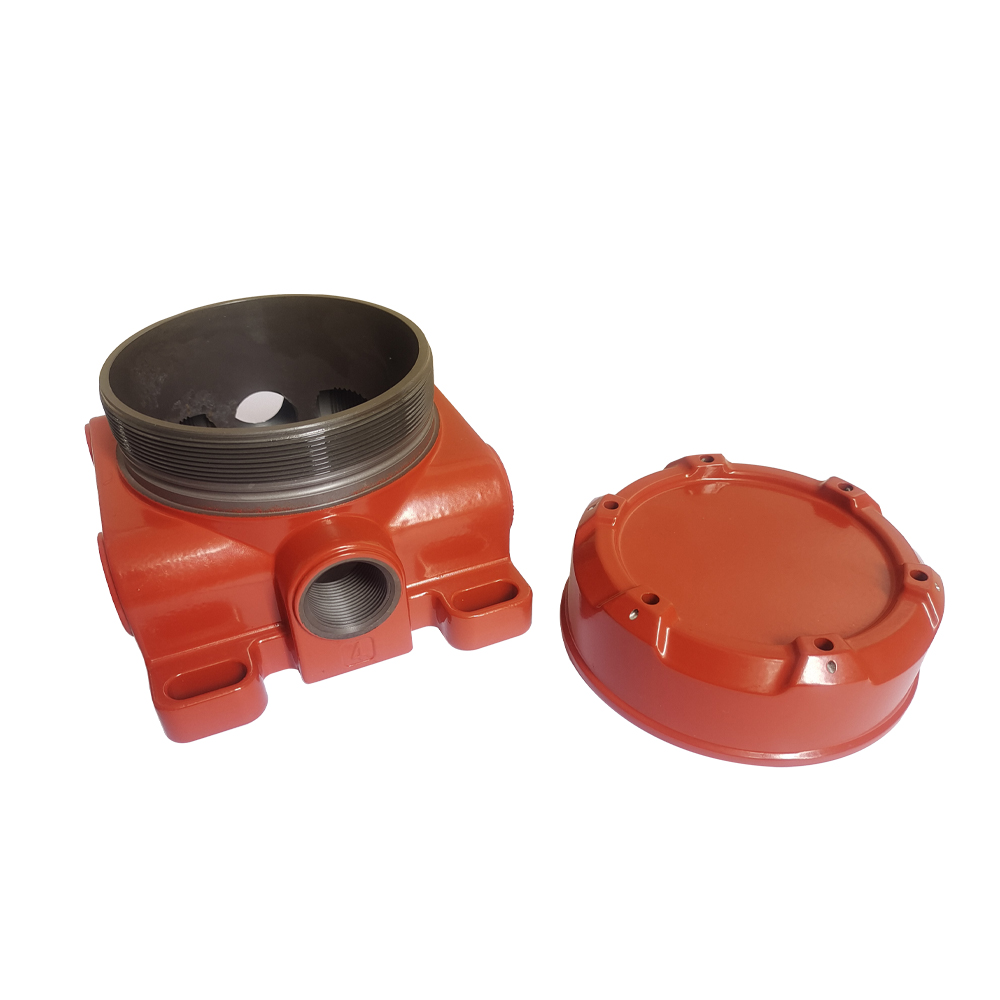
Why the Right Tonnage Is the Most Under-Engineered Variable on a Housing Program
Clamping force is the force the die casting machine exerts to keep the die halves closed against the internal cavity pressure during injection. Intensification pressure is the additional pressure applied to the metal in the last 10–20% of the shot stroke, after the cavity is filled, to pack additional material into shrinkage voids as the casting solidifies. The clamping force has to be high enough to resist the intensification pressure on the projected area of the part; if it is not, the die halves separate slightly at the parting line and at the overflow-well seals during intensification, and the resulting flash and back-flow leave internal porosity in the casting.
The defect is invisible on the surface. It shows up on the X-ray as clusters at the heavier-section centers and at the rib-to-wall junctions. It is the most expensive defect to find late in the program because it survives cosmetic inspection and only fails on the buyer’s pressure test or X-ray at receiving. Under-clamping is the most expensive die casting mistake on a complex housing program.
How Clamping Force Maps to Projected Area
The calculation is straightforward. Projected area is the silhouette of the part viewed from the direction of clamp force (perpendicular to the parting line). It is the area the clamping force has to resist against the cavity pressure. The rule of thumb for cold-chamber aluminum is:
The lower end of the band (6 t/cm²) is for simple geometries with uniform wall thickness. The upper end (8 t/cm²) is for thin-walled complex housings with multiple ribs, where higher intensification pressure is needed to fill the cavity before the casting starts to solid before the cavity is fully filled. A buyer who under-specifies the tonnage to save on machine cost pays for it later in porosity rejects.
The 280T-800T Range, in Practice
At Ningbo Jiangbei XinYe, the four-machine cold-chamber die casting range maps to typical Ningbo aluminum housing programs as follows. The mapping is not a recommendation of which machine is best for every part — it is a working guide for which machine to put a new part on when the buyer has not specified a machine tonnage.
| Machine tonnage | Typical projected area | Typical housing types | Typical shot |
|---|---|---|---|
| 280T (cold-chamber) | up to ~400 cm² | Small covers, brackets, connector housings under ~200 mm in longest dimension | 0.5–1.5 kg |
| 400T (cold-chamber) | up to ~600 cm² | Motor housings, gearbox covers, instrument enclosures | 1–3 kg |
| 500T (cold-chamber) | up to ~800 cm² | Industrial gearbox bodies, pump housings, mid-size structural enclosures | 2–4 kg |
| 800T (cold-chamber) | up to ~1,200 cm² | Large-format gear housings, transmission cases, complex multi-feature enclosures | 3–7 kg |
Specialty housings outside this range need a different conversation. The four-machine range above covers roughly 90% of the aluminum-housing volume a typical Ningbo OEM program asks for, which is why this is the practical range for an aluminum-focused forging manufacturer with casting capability like XinYe.
Why Cold-Chamber, Not Hot-Chamber
Cold-chamber die casting uses a separate furnace to melt the aluminum and a ladle to inject the molten metal into the shot sleeve; the shot sleeve and the plunger are not in contact with the melt pot. Hot-chamber die casting submerges the shot mechanism in the molten metal pot and is used for low-melting-point alloys (zinc, magnesium, lead).
Aluminum die casting is almost always cold-chamber for two physical reasons. First, aluminum’s melting point (~660 °C) is above the working temperature of steel shot sleeves and plungers; hot-chamber operation would burn out the pot and the plunger in hours. Second, molten aluminum is chemically reactive with iron (the steel sleeve material); the iron pickup contaminates the alloy and degrades the casting. Cold-chamber operation puts a measured ladle of metal into the shot sleeve for each shot, which avoids both problems.
The 280T-800T cold-chamber machine range discussed here is the standard configuration for aluminum housing programs. Hot-chamber machines are used for the few aluminum die casting programs that involve magnesium-aluminum alloys with iron-free shot sleeves (steel replacement with titanium or ceramic), but those are the exception rather than the rule.
How Intensification Pressure and Clamping Force Interact
For aluminum cold-chamber die casting, intensification pressure of 350–700 bar (5,000–10,000 psi) is typical. The clamping force has to be high enough to resist that intensification pressure on the projected area of the part. The rule of thumb is:
A buyer who runs 600 bar intensification on a 600 cm² projected area housing needs clamping force of roughly 540–720 tonnes — right in the middle of the 400T-800T range. A buyer who runs 800 bar intensification on the same housing needs clamping force of 720–960 tonnes, which pushes the part out of the standard range and into the 1,250T+ machine category. Intensification pressure is the lever that decides which machine in the range is the right one.
How Undersized Clamping Force Causes Porosity
Under-clamping force allows the die halves to separate slightly at the parting line and at the overflow-well seals during intensification. The separation creates flash and, more importantly, allows molten aluminum to back-flow out of the cavity, which leaves a void inside the casting. The voids are shrinkage porosity in the typical case and gas porosity in the rarer case, and they show up in the X-ray as clusters at the heavier-section centers of the part and at the ribs-to-wall junctions.
The defect is hidden inside the casting. A buyer who buys on appearance and skips the X-ray will accept the lot and find the porosity in service. A buyer who runs the X-ray at incoming inspection will reject the lot on first inspection and force a conversation about clamping force. The buyer who runs the X-ray forces the supplier to run the right machine.
ASTM E505 (Standard Reference Radiographs for Inspection of Aluminum and Magnesium Castings) is the international standard that defines the severity levels for this defect. ISO 7755 covers the parallel classification system for aluminum and aluminum-alloy casting defects, which is the international cross-reference most European buyers cite alongside ASTM E505. A typical buy-and-supplier agreement uses E505 severity level 2 or 3 as the acceptance threshold, with no linear porosity or no shrinkage porosity at level 4 or above. The agreement is signed before the first sample; the X-ray reference radiographs are part of the package.
Flash: The Warning Symptom of Under-Clamping
Flash is the thin fin of metal that escapes between the die halves at the parting line when the cavity pressure exceeds the clamp force. Flash is the visible symptom of under-clamping; it tells the operator that the machine is at its clamp limit and the next heavier machine is the right answer.
A consistent flash pattern across all cavities on every shot is a clamping problem — the part is on the wrong machine. Flash on a single shot is a different problem — thermal expansion of the die at the parting line, a die-stretch problem from cavity pressure imbalance, or a worn parting-line insert. Both need attention, but the remedy is different for each.
A buyer who specifies the right machine tonnage up front and runs a pressure-test qualification on the first article avoids the flash conversation on every production lot. The pressure test catches flash that the cosmetic inspection misses, and the X-ray catches porosity that the pressure test misses. Both gates are part of the standard buy-and-supplier agreement for a complex aluminum housing.
How to Match the Tonnage to the Part
The three-step calculation that arrives at the right machine tonnage is straightforward:
- Projected area in cm² = the silhouette area of the part measured perpendicular to the clamp direction at the parting line. For a part with a complex silhouette, take the maximum silhouette area at each hole angle and use the maximum. For a two-cavity die with two different projections, take the larger.
- Clamp force required = projected area × 6–8 tonnes/cm² for standard cold-chamber aluminum (8–10 for thin-walled complex housings, 5–6 for simple geometries).
- Safety margin = add 10–20% to the calculated value for die-stretch and intensification overshoot, then round up to the nearest standard machine size in the 280T-800T range.
A buyer who follows this calculation arrives at the 280T-800T range for roughly 90% of typical Ningbo aluminum housing programs. The other 10% — very small precision parts or very large structural parts — need a different conversation with the foundry about machine selection.
The Alloy and the Geometry Matter as Much as the Tonnage
Clamping force is necessary but not sufficient. The other two variables that decide whether a complex aluminum housing comes out of the die clean are:
- Alloy selection. A380 and A383 are the dominant general-purpose aluminum die casting alloys; A390 is the high-silicon alloy for wear applications; ADC12 is the JIS equivalent for the Asia-Pacific market. Each alloy has its own recommended intensification pressure and its own flow characteristics, and the tonnage calculation should reflect the alloy choice. ISO 3522 and ASTM B85 give the chemical composition limits and mechanical property ranges for these alloys. EN 1706 is the parallel European standard for chemical composition and mechanical properties, and the standard most European buyers cite alongside the ASTM/ISO framework.
- Geometry draft and overflow. A thin-walled complex housing with poor draft and undersized overflow wells will see cold-shut defects and incomplete fill regardless of tonnage. The draft angle should be 1–3° on interior surfaces and 2–3° on exterior surfaces for most aluminum die casting alloys.
The right machine tonnage is necessary but not sufficient for a clean casting. The right alloy, the right draft, the right overflow, the right intensification pressure, the right gate design, and the right cooling shot are the full list. A buyer who treats the tonnage choice as one of six variables, not the only variable, avoids the porosity conversation later in the program.
How This Connects to the XinYe Production Capability
Ningbo Jiangbei XinYe runs the 280T-800T cold-chamber range as part of a broader production capability that also covers CNC machining, aluminum hot forging, lost wax casting, and stamping & deep drawing. A buyer who needs a complex aluminum housing plus the matching forged flange or machined interface features can run the whole part at XinYe under one quality program.
The four-machine range is sized for the typical Chinese OEM program that puts 2,000–50,000 parts per year through a single aluminum housing SKU. The process control and acceptance criteria across this volume band typically follow the NADCA product specification standards (or their European equivalent), which set the agreed acceptance limits for porosity, surface finish, and dimensional tolerance on the buy-and-supplier agreement. Specialty housings outside this range are possible at the same foundry on a sub-tooling or a custom machine, but the unit cost climbs quickly because the machine dies and the excess capacity charge.
How to Walk the Conversation With Your Die Casting Supplier
A typical inquiry that lands on our desk looks like this: an Italian OEM of industrial pumps needs a 450 mm × 380 mm aluminum gearbox housing with three integrated bearing pockets and one M30 mounting boss. The conversation runs:
- Confirm the part. The buyer sends the CAD or a sample; we calculate the projected area and the estimated shot weight.
- Confirm the alloy. We recommend A380 or A383 as the default; ADC12 if the buyer is in the Asia-Pacific market and wants a JIS-spec alloy; A390 if the bearing pockets see wear.
- Confirm the machine tonnage. With a projected area of ~650 cm², the calculation puts the part on the 500T machine, which is in the middle of the four-machine range.
- Confirm the draft and the overflow; we suggest adjustments that cut porosity risk.
- Confirm the first-article qualification. We run a first article, machine-buy the part, X-ray per ASTM E505, pressure-test, and report results before the buyer commits to production.
For OEM programs at scale, the same conversation is the qualification cycle that establishes the foundry as an approved supplier. A 2,000-piece first order is typical for that qualification; the per-piece cost is lower than the small-quantity quote because the setup is amortized across the run.
FAQ
What is the right die casting machine tonnage for a complex aluminum housing?
What is the difference between projected area and total surface area, and why does it matter for clamping force?
How does undersized clamping force cause porosity in aluminum die castings?
What is the relationship between clamping force and intensification pressure?
What is the difference between cold-chamber and hot-chamber die casting, and which does an aluminum housing need?
How does the 280T-800T machine range map to typical aluminum housing programs?
What is flash and how does it relate to clamping force?
How do I select the right machine tonnage for a new aluminum housing?
How does the cold-chamber cycle time differ across the 280T-800T range?
What is the most common die casting defect on complex aluminum housings?
Working on an aluminum housing program and want to walk the tonnage calculation?
Email alison@cnnbxy.com · Tel +86-574-87526267 · Review our production capability — die casting equipment and aluminum die casting parts manufacturer range, or see our forging manufacturer with casting capability profile.
Alison Pan
Alison Pan is the International Sales Manager at Ningbo Jiangbei XinYe Metal Works Co., Ltd., the Ningbo-based aluminum die casting parts manufacturer behind cnnbxinye.com. The factory pairs Japanese-sourced core production equipment with a strict multi-stage quality-control program (ISO 9001-aligned QC program with documented per-heat records) to deliver forging rings, lost-wax castings, and stamped-steel components for OEM and ODM partners worldwide. Alison’s work centers on technical drawing review, material selection, and order scheduling, with a focus on reducing tooling iteration cycles and aligning every shipment with the buyer’s incoming-inspection plan.
← Forging Parts Manufacturer (aluminum die casting) · Production Capability → · Forging Manufacturer with Casting Capability
Post time: Sep-20-2026